
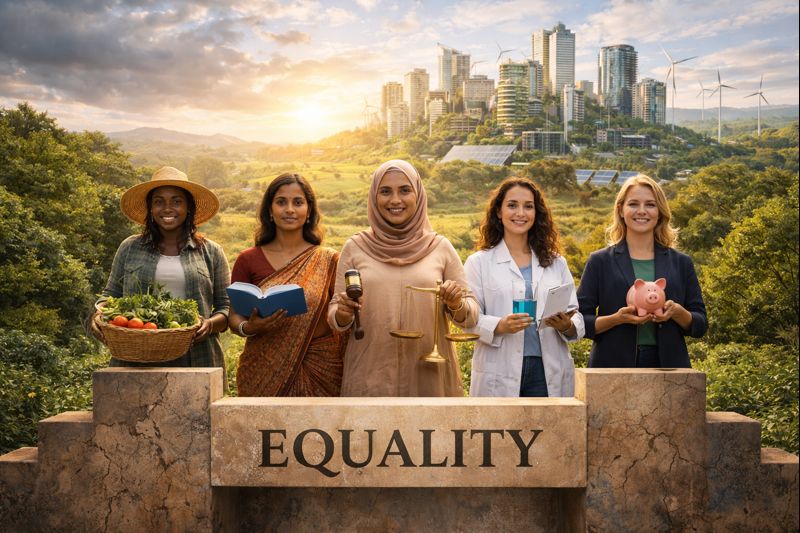
“There is no tool for development more effective than the empowerment of women.” – Kofi Annan
Sustainable development is often discussed in terms of carbon neutrality, economic indicators, and institutional reforms. Yet, when viewed solely through technocratic frameworks, it becomes incomplete sometimes even hollow. True sustainability does not emerge from spreadsheets alone; it rises from lived realities, shared power, and social justice. Through women’s lens, sustainable development transforms from a policy ambition into a human promise.
Women are not merely beneficiaries of sustainable development; they are its architects, accelerators, and ethical compass. From village economies to global boardrooms, women continuously reshape how societies grow, endure crises, and define progress. When women are excluded, development limps. When women lead, development endures.
This is not ideology, it is evidence.
Reframing Sustainability Through Equality, Not Charity
Equality is often misunderstood as a moral concession rather than an economic necessity. Yet gender equality is the bedrock upon which sustainable development stands. Without equitable access to education, healthcare, political representation, and economic resources, sustainability becomes a privilege for a few rather than a pathway for all.
Women experience systemic barriers not because of lack of capability, but because of structural inertia laws that ignore unpaid care work, markets that undervalue women’s labour, and institutions designed without women’s voices. Sustainable development, when filtered through women’s lived experiences, exposes these blind spots with unmistakable clarity.
Equality from a women’s lens is not symbolic inclusion; it is redistributive justice. It questions who controls resources, who shapes policies, and whose labour remains invisible. When women gain equal footing, societies unlock dormant potential higher productivity, stronger social cohesion, and intergenerational stability.
As economist Amartya Sen Says:
“Development is freedom.”
For women, equality is that freedom, the freedom to choose, to contribute, and to thrive without constraint.
Resilience Is Feminine by Design
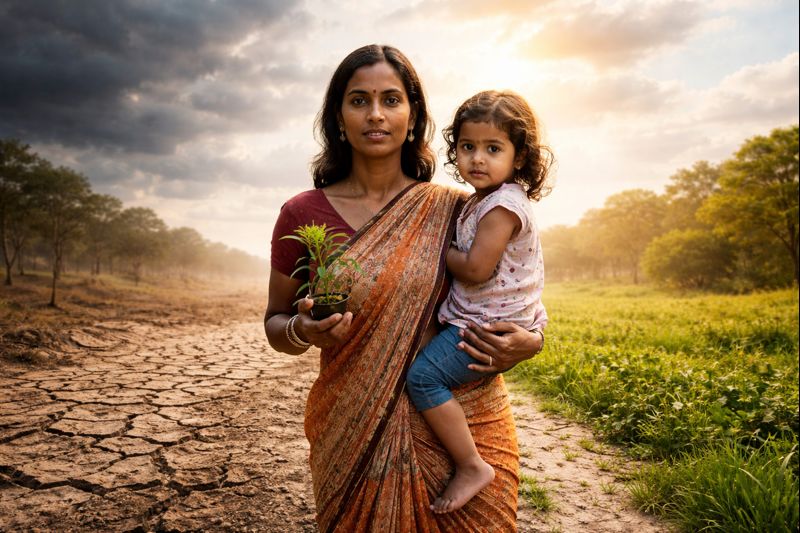
Resilience is often romanticised during crises, but rarely analysed through gender. Yet, if resilience had a human face, it would look unmistakably female.
Women absorb shocks long before institutions respond. During climate disasters, economic downturns, pandemics, and conflicts, women adapt households, preserve food security, sustain informal economies, and rebuild social networks. This is not accidental; it is systemic resilience born of responsibility without authority.
From women farmers innovating climate-smart agriculture to caregivers sustaining communities during health emergencies, women convert scarcity into survival. Sustainable development that ignores this reality miscalculates resilience itself.
A women-centred sustainability framework recognises resilience not as endurance alone, but as transformative strength, the ability to adapt while demanding systemic change. When women are included in disaster planning, climate governance, and economic recovery, societies rebound faster and fairer.
“Resilience is not about bouncing back; it is about bouncing forward.”
And women, globally, are already doing so often without recognition, resources, or representation.
Economic Growth That Breathes, Not Breaks
Growth that widens inequality is not growth; it is extraction. Traditional economic models have long treated women as secondary participants, relegating their contributions to the margins. Yet evidence consistently shows that women’s economic participation strengthens GDP, stabilises markets, and future-proofs economies.
Women reinvest earnings into families, education, and health at higher rates, creating multiplier effects that benefit entire communities. Inclusive economies are not softer they are stronger, smarter, and more shock-resistant.
When women access land rights, credit systems, digital tools, and leadership roles, economic growth becomes sustainable rather than volatile. It shifts from short-term accumulation to long-term value creation.
The women’s lens challenges the extractive logic of growth and replaces it with regenerative economics where care, equity, and sustainability coexist with profitability.
“An economy that works for women works for everyone.”
Climate Justice Begins With Women
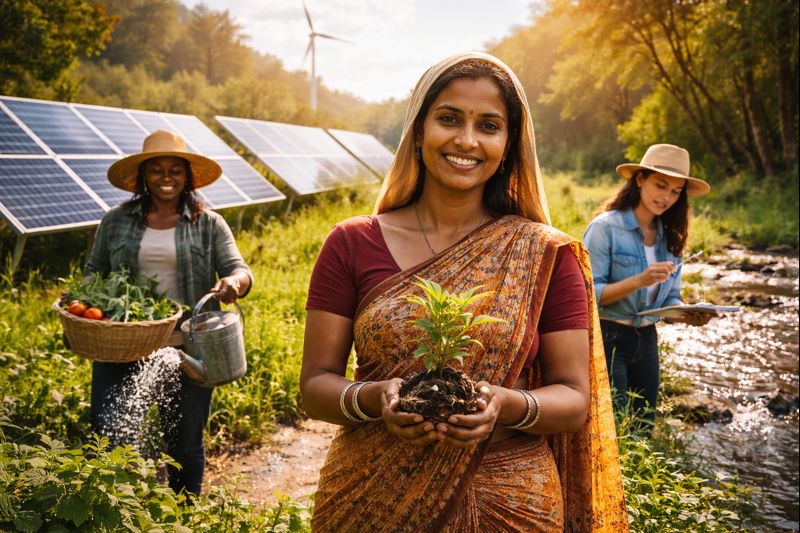
Climate change is not gender-neutral. Women, particularly in developing regions, face disproportionate impacts due to economic precarity, caregiving burdens, and limited access to resources. Yet they are also among the most innovative climate leaders.
From renewable energy entrepreneurship to conservation movements, women are at the forefront of climate adaptation and mitigation. A sustainable future demands that climate policy move beyond neutrality toward gender-responsive climate action.
Women’s ecological knowledge often dismissed as informal is in fact deeply scientific, intergenerational, and sustainable. When women are included in environmental governance, conservation outcomes improve, and community buy-in strengthens.
Sustainability, through women’s eyes, is not abstract environmentalism; it is survival with dignity.
Leadership That Redefines Power
Power, traditionally defined, dominates. Power, through women’s leadership, transforms.
Women leaders are statistically more likely to invest in social infrastructure, prioritise transparency, and govern collaboratively. This is not coincidence it reflects lived realities where leadership is rooted in accountability rather than control.
From grassroots movements to national parliaments, women’s political participation reshapes governance priorities toward education, healthcare, climate resilience, and inclusive growth. Sustainable development flourishes where leadership mirrors society, not elites.
“The future of leadership is not louder; it is fairer.”
When women lead, sustainability becomes policy, not rhetoric.
The Intergenerational Promise of Women-Centred Development
Perhaps the most profound contribution women make to sustainable development is intergenerational continuity. Women think beyond election cycles and profit margins; they plan for children not yet born.
Education for girls delays poverty. Healthcare for mothers strengthens nations. Economic security for women stabilises future workforces. This is sustainability in its truest sense development that outlives the present.
A women’s lens insists that progress today must not compromise tomorrow. It reframes sustainability as stewardship, not exploitation.
Rewriting the Development Narrative
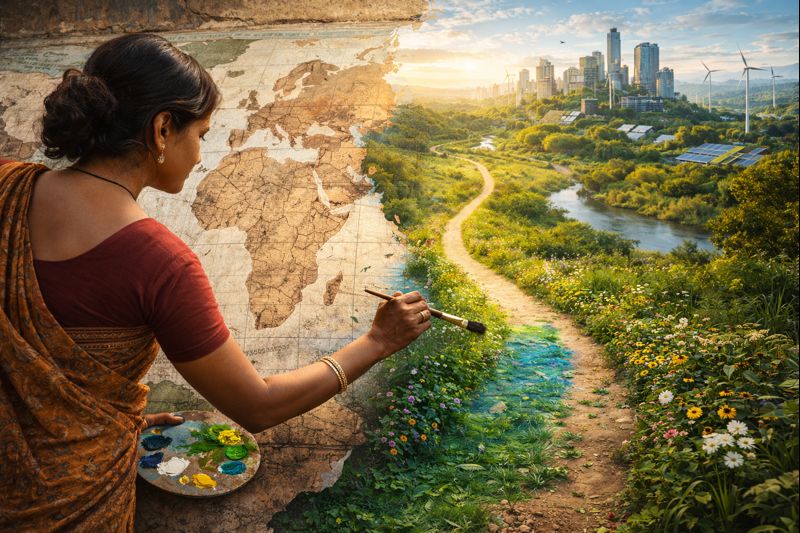
Sustainable development from women’s lens is not an alternative agenda it is the missing centre of global progress. Equality ensures fairness. Resilience secures survival. Inclusive growth sustains prosperity.
Ignoring women in development is no longer ignorance; it is negligence.
As societies confront climate volatility, economic uncertainty, and social fragmentation, the path forward is clear. Invest in women, not as a moral gesture, but as a strategic imperative.
“When women rise, nations rise.”
Sustainability is not achievable without women. It never was.
For more understanding –
- UN Women – Gender Equality and Sustainable Development
https://www.unwomen.org/en/what-we-do/economic-empowerment - World Economic Forum – Gender Parity and Economic Growth https://www.weforum.org/topics/gender-equality
- World Bank – Women, Business and the Law https://www.worldbank.org/en/programs/women-business-and-the-law
- UNDP – Gender and Climate Change https://www.undp.org/gender/climate-change
- OECD – Women’s Economic Empowerment https://www.oecd.org/gender