

There is a paradox at the heart of modern healthcare. Never before has the world spoken so loudly about gender equality yet millions of women still slip quietly through the fissures of health systems that were never fully designed to see them.
Policies, Programs and Funding lines exist. But still, the lived reality of many women tells a different, more unsettling story. Because when gender intersects with health policy, the outcome is rarely neutral. It is shaped by power, by priorities, by whose bodies were studied first and whose pain was historically dismissed. It is shaped by invisible assumptions embedded deep within bureaucratic frameworks.
In the first article of this series, Time to Bring Women’s Health Into the Light, we confronted the biological and social differences that demand a gender-specific lens. Now the conversation must move upstream into the policy corridors where decisions are made, budgets are allocated, and, too often, women’s needs are diluted into generalities.
As Ruth Bader Ginsburg once declared:
“Women belong in all places where decisions are being made.”
Health policy is one of those places. And until women’s realities are structurally embedded into policy design, they will continue to fall through the cracks quietly, consistently, and unjustly.
When Good Intentions Aren’t Good Enough
Across the globe, most health policies claim to be “gender inclusive.” The language is polished. The commitments appear progressive. Yet outcomes reveal a more complex truth.
Policies often treat women as a homogenous group or confine their needs narrowly to maternal and reproductive health. While these areas are undeniably critical, this reductive framing creates a dangerous blind spot. Women’s cardiovascular risks, autoimmune conditions, mental health burdens, occupational exposures, and aging-related challenges frequently remain under-prioritized in national health agendas.
The problem is not always absence of intent, it is absence of precision. Many policy frameworks operate on what experts call gender neutrality, assuming that what works for the general population will work equally for women. But neutrality in unequal systems often perpetuates inequality. When baseline structures are male-centric, neutral policies simply preserve the status quo.
Institutions such as the World Health Organization have repeatedly emphasized about the need for gender-responsive health systems, yet implementation remains uneven and, in many regions, painfully slow.
The Policy Design Gap: Where Women Become an Afterthought
Health policies rarely fail because of overt exclusion. More often, they falter through subtle design flaws that quietly marginalize women.
Consider how many national insurance packages cover pregnancy-related care but provide limited support for postpartum mental health. Or how workplace health policies may protect against physical injury but overlook chronic stress, burnout, and reproductive health needs.
These gaps emerge during the policy design phase when the decision-makers rely on incomplete gender-disaggregated data, when consultation processes exclude grassroots women’s voices, or when budget allocations prioritize high-visibility interventions over long-term preventive care. The result is a pattern of systemic leakage.
Women enter the healthcare pipeline, but somewhere along the continuum screening, diagnosis, treatment, follow-up, they fall through. The UN Women has consistently warned that without gender mainstreaming in policy planning, even well-funded health programs can produce inequitable outcomes.
Policy, in other words, is not merely administrative, it is profoundly human in its consequences.
Intersectionality: The Multiplier Effect of Inequality
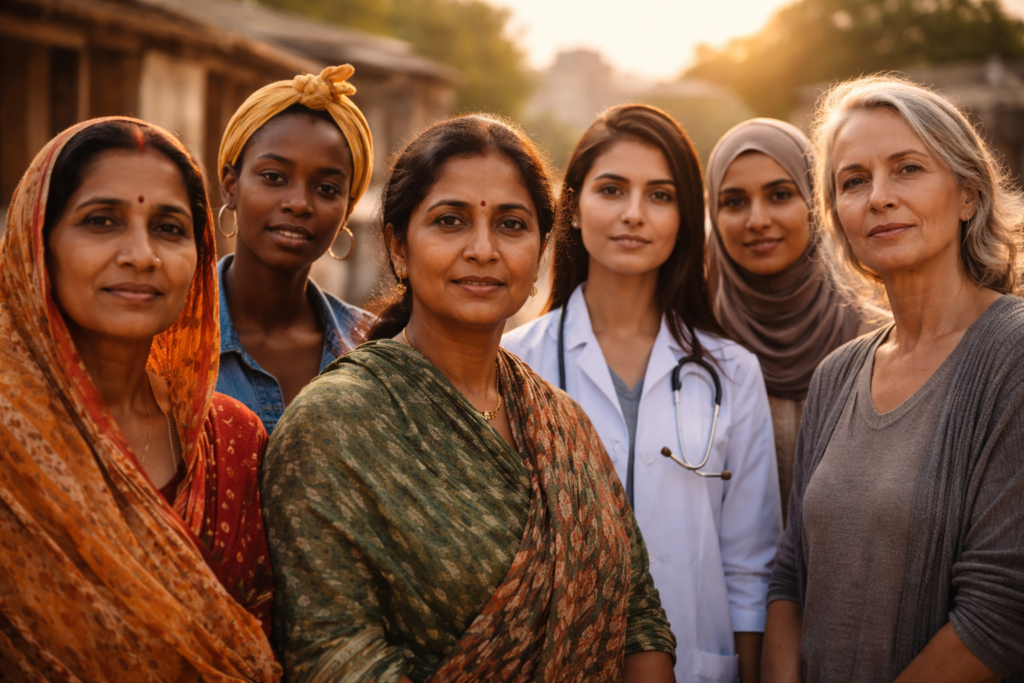
To understand why some women fall further and faster through the cracks, we must confront a critical truth: women are not a monolith.
Gender intersects with geography, income, caste, race, disability, age, and education to create layered vulnerabilities. A well-educated urban woman and a rural woman with limited mobility do not encounter the health system in the same way. Nor do adolescent girls, migrant workers, widows, or elderly women living alone. This is where many policies reveal their fragility.
Programs that rely on a “one-size-fits-all woman” approach often overlook those living at the margins. In many regions, weak rural health infrastructure keeps care physically out of reach. Documentation barriers block urban slum populations from accessing essential services. Inaccessible facilities continue to shut out women with disabilities. Meanwhile, residency-linked insurance schemes frequently leave migrant women without coverage.
The intersection of gender and structural inequality creates what public health scholars describe as compounded disadvantage.
Until policy frameworks actively map and address these intersections, the most vulnerable women will continue to remain statistically invisible and practically underserved.
The Funding Paradox: Where the Money Goes and Doesn’t
Follow the money, and the story becomes even clearer. Globally, women’s health funding still skews heavily toward maternal and child health. While this investment has saved countless lives, it has also inadvertently narrowed the policy imagination around women’s broader health needs.
Non-communicable diseases are the leading cause of death among women worldwide and often receive less gender-targeted attention. Mental health services for women remain under-resourced in many countries. Menopause care, despite affecting half the population at midlife, is strikingly absent from most national health strategies.
Even research funding reflects this imbalance. This is not merely a budgeting issue but it is a question of visibility and value. What health systems choose to fund reveals what they choose to prioritize. And historically, the full spectrum of women’s health has not received proportional attention.
The Implementation Chasm: Policies on Paper vs. Reality on the Ground
Even when policies are well-crafted, another formidable barrier emerges: implementation.
In many regions, gender-sensitive policies exist in official documents but fail to translate into frontline practice. Health workers may lack gender training. Facilities may be understaffed. Supply chains may be inconsistent. Cultural norms may discourage women from seeking care despite policy availability.
This implementation chasm is particularly visible in rural and resource-constrained settings.
For example, screening programs for cervical or breast cancer may be formally included in national plans, yet uptake remains low due to lack of awareness, transportation barriers, stigma, or workforce shortages. Policy success, therefore, cannot be measured solely by adoption. It must be evaluated by lived impact.
As Gro Harlem Brundtland powerfully stated:
“Health is a political choice.”
And so is effective implementation.
The Silence Around Midlife and Aging Women
One of the most conspicuous policy blind spots lies in the health of midlife and older women.
Adolescence and maternity receive attention. Early childhood receives attention. But the decades between reproductive years and old age often dissolve into policy invisibility.
Perimenopause, menopause, osteoporosis, cardiovascular transitions, cognitive health, and long-term caregiving strain, these are not niche concerns. They affect hundreds of millions of women globally. Yet many national health strategies still lack comprehensive menopause guidance, midlife screening protocols, or workplace protections for menopausal symptoms.
This silence is not accidental. It reflects enduring ageism layered onto gender bias. Healthy aging for women must become a central pillar of health policy not an afterthought appended to maternal frameworks.
Digital Health: A New Frontier With Old Risks

The rapid expansion of digital health offers extraordinary promise but also new equity risks.
Telemedicine, AI-driven diagnostics, and mobile health platforms can dramatically improve access for women constrained by geography or mobility. However, the gender digital divide remains real. Women in many regions have lower smartphone ownership, reduced internet access, and less digital literacy.
If digital health systems are deployed without gender-sensitive design, they risk reproducing existing inequities in more technologically sophisticated forms. Encouragingly, organizations like the World Health Organization are increasingly emphasizing gender equity in digital health strategies. But vigilance is essential.
Innovation without inclusion can widen the very gaps it aims to close.
From Awareness to Action: What Transformative Policy Looks Like
Real progress requires moving beyond rhetorical commitment into structural transformation.
Gender-responsive health policy is not a one-time intervention and a profound ecosystem transformation. It begins with robust sex-disaggregated data across every layer of surveillance, advances through participatory policy design that meaningfully includes women from diverse communities, and is sustained by budgeting frameworks that deliberately track and deliver measurable gender-equity outcomes.
Training frontline health workers in gender-sensitive care is equally critical. So is embedding accountability mechanisms that measure whether policies are actually reaching the women most at risk. Perhaps most importantly, it requires political courage, the willingness to redesign systems that have long operated on inherited assumptions.
Change of this magnitude is neither quick nor easy. But it is profoundly possible.
The Road Ahead: Rewriting the Policy Playbook
We are standing at a decisive moment in global health. The evidence is no longer ambiguous. The gender gaps are documented. The economic case for investing in women’s health is compelling. The moral case is undeniable.
What remains is the collective will to act with urgency and precision. Bringing gender into the center of health policy is not about creating special treatment. It is about correcting historical distortion, designing systems that reflect biological realities and social truths. It is about ensuring that no woman regardless of where she lives or what stage of life she occupies has to navigate a health system that was never fully built for her.
The future of equitable healthcare will belong to systems that are gender-intelligent, intersection-aware, and relentlessly inclusive.
Anything less is no longer acceptable.
This conversation does not end here, it deepens.
In the next article of this series “The Impact of Social Determinants on Women’s Health Outcomes” we will examine how education, income, environment, nutrition, and social norms profoundly shape women’s health trajectories long before they enter a clinic. Because policy is only one piece of the puzzle. The social ecosystem around women’s lives matters just as much.
Stay with this series. The most important insights are still unfolding.
- World Health Organization. Gender Responsive Health Systems.
https://www.who.int/health-topics/gender - UN Women. Gender Equality in Health Systems.
https://www.unwomen.org/en/what-we-do/health - The Lancet Commission on Women and Health.
https://www.thelancet.com/commissions/women-and-health - World Bank. Gender and Health Overview.
https://www.worldbank.org/en/topic/health/brief/gender-and-health