
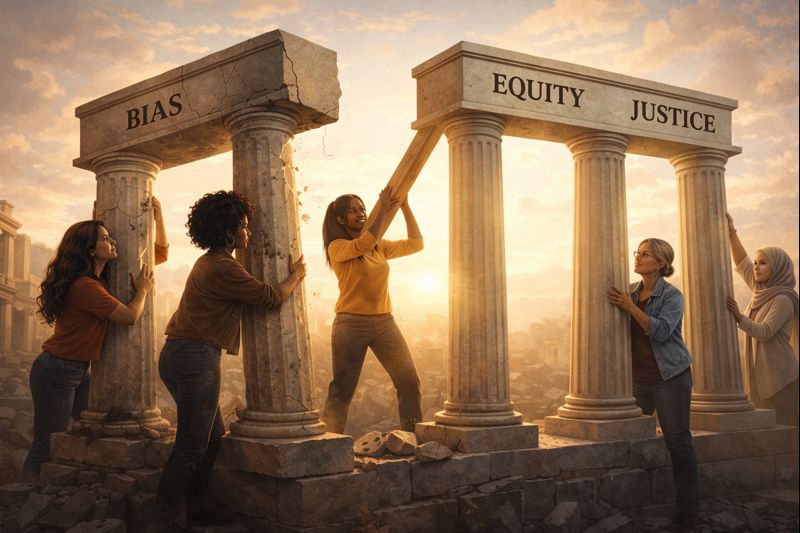
“There is no such thing as a single-issue struggle because we do not live single-issue lives.” – Audre Lorde
For decades, inequality was discussed as if it existed in neatly separated compartments race here, gender there, class somewhere in the background. Policies were drafted, movements were launched, and narratives were shaped around isolated identities. But real lives were never that simple. Real people were never that singular. Today, the invisible seams that once concealed overlapping oppression are finally being exposed. Intersectionality has moved from the margins to the centre of global discourse, demanding not just recognition, but reckoning.
This is the era where intersections are no longer theoretical, they are visible, lived, and undeniable.
When Inequality Refuses to Stay in One Box

A woman does not experience gender in isolation. A person of colour does not experience race without class. A low-income individual does not experience poverty divorced from gender norms or racial hierarchies. These identities interlock, overlap, and compound, shaping opportunity, access, and dignity in profoundly unequal ways.
The concept of intersectionality, coined by legal scholar Kimberlé Crenshaw, was never meant to be academic jargon. It was a diagnostic tool a way to expose how systems of power collide rather than merely coexist. Intersectionality reveals why certain voices are consistently unheard, why some bodies are disproportionately policed, and why progress often bypasses those who need it most.
In a world obsessed with averages and generalisations, intersectionality insists on specificity. It asks: Who is being left behind, and why – again?
The Silent Weight of Compounded Disadvantage
To understand intersectional inequality is to confront an uncomfortable truth: oppression multiplies. A privileged woman may face sexism, but she may also benefit from racial or economic advantage. Meanwhile, a working-class woman from a marginalised racial group does not experience discrimination in layers she experiences it all at once.
Consider labour markets. Gender pay gaps persist globally, yet they widen dramatically when race and class enter the equation. Women of colour are not merely paid less than men; they are paid less than white women. Informal work, domestic labour, and precarious employment disproportionately absorb women from lower socio-economic backgrounds, locking them into cycles of economic vulnerability.
This is not accidental. It is structural. Systems were designed to reward proximity to power and punish distance from it.
Gender Is Political, Race Is Economic, Class Is Cultural
Intersectionality reveals how power disguises itself. Gender inequality is often framed as a cultural issue. Racial inequality is reduced to prejudice. Class inequality is dismissed as individual failure. But these forces are deeply political and economically engineered.
Access to quality education, healthcare, housing, and justice is filtered through racialised and gendered class structures. A girl’s future can be determined not by her potential, but by her postcode, her surname, and the colour of her skin. Her aspirations are shaped by what society silently signals is “appropriate” for someone like her.
As sociologist Pierre Bourdieu argued, inequality is not merely material, it is symbolic. Power reproduces itself through norms, language, and expectation.
Visibility as Resistance
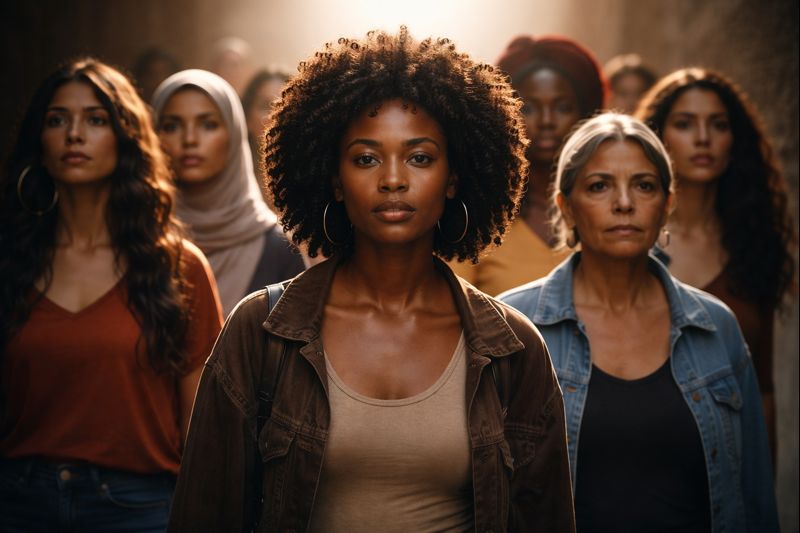
Visibility is not vanity. For marginalised communities, visibility is survival.
When stories remain untold, injustice remains uninterrupted. Intersectionality forces institutions to confront the people they have historically erased disabled women, migrant workers, Indigenous communities, LGBTQ+ individuals living in poverty. These are not “edge cases”; they are the centre of the problem.
Digital activism, feminist scholarship, and grassroots movements have played a critical role in amplifying these voices. Hashtags, testimonies, and transnational solidarity have transformed private pain into public accountability. Still, visibility without action risks becoming performative. Representation alone cannot dismantle systems built on exclusion.
As bell hooks warned, “Feminism is for everybody,” but only if it refuses to centre only the most comfortable voices.
The Cost of Ignoring Intersectionality
When policies ignore intersectionality, they fail. Gender-neutral policies overlook how women are positioned differently in society. Race-blind policies perpetuate racial inequities under the illusion of fairness. Class-agnostic reforms privilege those who already possess social capital.
Economic recovery plans that do not address unpaid care work burden women further. Climate policies that ignore Indigenous knowledge replicate colonial harm. Criminal justice reforms that overlook racial bias reinforce incarceration cycles.
Intersectionality is not ideological, it is pragmatic. It improves policy outcomes, strengthens democratic participation, and builds social resilience. Ignoring it is not neutrality; it is negligence.
Power, Privilege, and the Myth of Meritocracy
One of the most enduring myths sustaining inequality is meritocracy the belief that success is purely the result of effort. Intersectionality exposes how this narrative collapses under scrutiny.
Effort does not exist in a vacuum. Opportunity is unevenly distributed long before ambition has a chance to operate. When race, class, and gender collide, they create invisible ceilings and sticky floors that effort alone cannot break.
Acknowledging privilege is not about guilt it is about responsibility. It is about understanding that equality requires more than identical treatment; it requires equitable redistribution of power and resources.
From Awareness to Structural Transformation
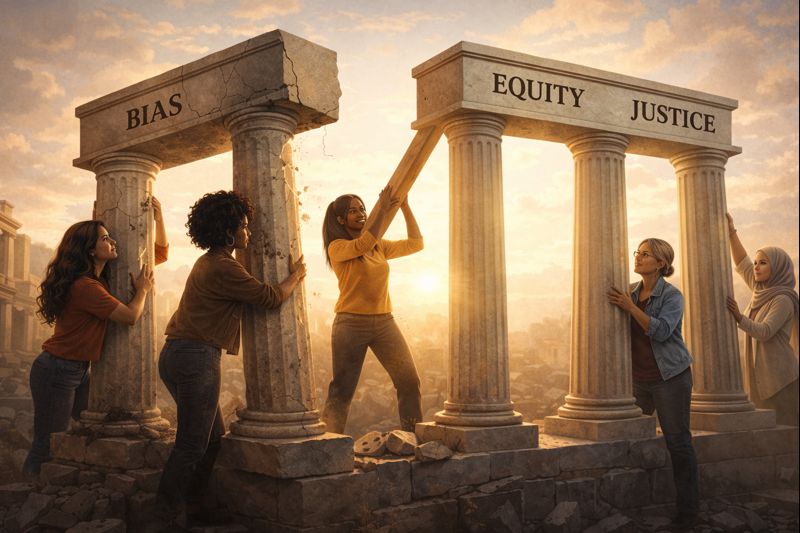
Intersectionality demands more than awareness campaigns. It demands structural change.
Education systems must integrate inclusive curricula that reflect diverse histories. Workplaces must dismantle biased hiring, promotion, and pay structures. Governments must collect disaggregated data to reveal who policies truly serve. Media must abandon monolithic narratives and embrace complexity.
Most importantly, those most affected by inequality must be at the decision-making table not as symbols, but as architects of solutions.
As Angela Davis powerfully stated, “It is not enough to be non-racist; we must be anti-racist.” The same applies to sexism and classism. Neutrality preserves injustice. Transformation requires intention.
Why Intersectionality Is the Future of Justice

Intersectionality is not a trend it is the future of social justice. In an increasingly interconnected world, single-axis thinking is obsolete. Global crises from pandemics to climate change do not impact everyone equally. They magnify existing fault lines.
By embracing intersectionality, societies can move from fragmented reforms to holistic justice. They can design solutions that are inclusive by design, not corrected after harm occurs. They can replace exclusion with empathy, hierarchy with humanity.
Intersectionality does not divide movements it strengthens them. It reminds us that liberation is collective, or it is incomplete.
Making the Invisible Impossible to Ignore
The intersections of race, class, and gender are no longer hidden in footnotes or academic texts. They are visible in wage gaps, maternal mortality rates, educational access, and political representation. They are visible in whose voices are amplified and whose are silenced.
The question is no longer whether intersectionality matters. The question is whether we are brave enough to act on what it reveals.
Because justice that excludes is not justice at all. And equality that ignores difference is merely another form of dominance.
“Freedom is not given; it is won and it must be won by everyone, or it is not freedom.”
For more understanding –
- Kimberlé Crenshaw – Mapping the Margins: Intersectionality
https://chicagounbound.uchicago.edu/uclf/vol43/iss1/8/ - bell hooks – Feminism Is for Everybody
https://www.plutobooks.com/9780745317335/feminism-is-for-everybody/ - Audre Lorde – Sister Outsider
https://www.penguinrandomhouse.com/books/39286/sister-outsider-by-audre-lorde/ - Angela Davis – Women, Race & Class
https://www.penguinrandomhouse.com/books/39287/women-race-and-class-by-angela-y-davis/ - UN Women – Intersectionality Explained
https://www.unwomen.org/en/news/in-focus/women-and-the-sdgs/intersectionality