
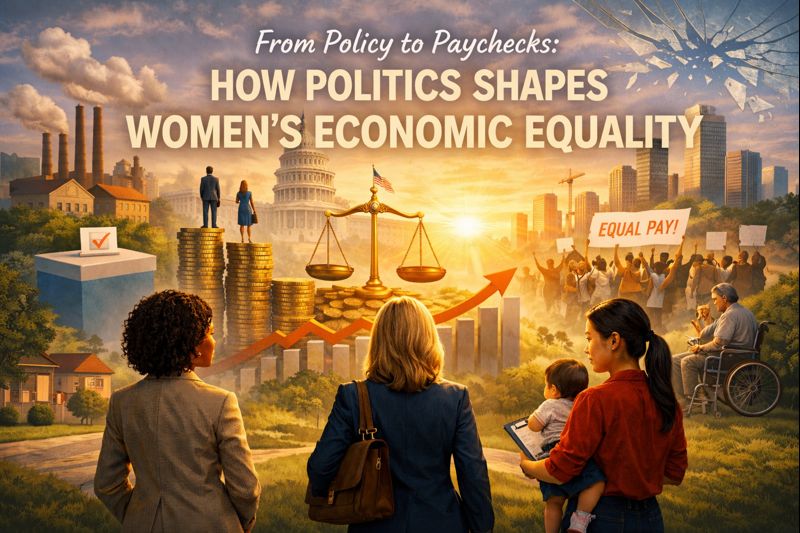
“When women are paid fairly, families thrive, economies grow, and societies move closer to justice.”
The Silent Inequality That Shapes Women’s Lives
The gender pay gap is not merely a statistic tucked away in economic reports it is a lived reality for millions of women across the world. Every unequal paycheck tells a story of undervaluation, systemic bias, and lost opportunity. Despite decades of progress in education, workforce participation, and leadership, women continue to earn less than men for work of equal value.

Globally, women earn on average 20% less than men, and in some regions, the gap is far wider. This disparity compounds over time, affecting women’s lifetime earnings, retirement security, health outcomes, and overall independence. The gender pay gap is not accidental; it is the outcome of historical exclusions, occupational segregation, unpaid care burdens, and policy failures.
“The pay gap is not a women’s issue – it is a policy issue.”
Political policies have the power to either sustain inequality or dismantle it. Economic equality will not emerge organically from markets alone; it must be designed, enforced, and protected through intentional governance.
Understanding the Gender Pay Gap Beyond Numbers
At its core, the gender pay gap reflects deeper structural inequalities. It is not only about unequal pay for the same job though that persists but also about who gets access to high-paying jobs, promotions, leadership roles, and economic security.
Many interconnected factors sustain this gap:
- Occupational segregation, where women dominate lower-paying sectors such as care, education, and service work
- Motherhood penalties, where women’s earnings decline after childbirth while men’s earnings often rise
- Unpaid care work, disproportionately shouldered by women
- Discrimination and bias, both overt and subtle
- Lack of wage transparency, allowing inequality to remain hidden
Without political intervention, these factors reinforce one another, creating a cycle that markets alone cannot correct.
“Equality delayed is equality denied – and policy delay is a form of injustice.”
Why Markets Alone Cannot Fix the Pay Gap
Free-market narratives often claim that competition will naturally eliminate wage disparities. Yet decades of evidence prove otherwise. Markets reflect existing power dynamics; they do not neutralize them.
When women’s labor is undervalued culturally, markets replicate that bias. When caregiving is unpaid, markets ignore its economic contribution. When leadership structures are male-dominated, markets reward continuity rather than equity.
Political policies are essential because they reshape incentives, correct imbalances, and protect rights. Without regulation, inequality becomes normalized.
Equal Pay Laws: Necessary but Not Sufficient

Equal pay legislation is the foundation of wage equality, but laws alone are not enough. Many countries have enacted equal pay laws, yet enforcement remains weak.
Effective policy must include:
- Clear definitions of “equal work” and “work of equal value”
- Strong enforcement mechanisms
- Meaningful penalties for violations
- Accessible legal recourse for women
When enforcement is symbolic rather than practical, inequality persists behind closed doors.
“A right without enforcement is merely a promise waiting to be broken.”
Pay Transparency: Turning the Lights On
One of the most powerful policy tools against the gender pay gap is pay transparency. When wages are hidden, discrimination thrives. When salaries are visible, inequality becomes undeniable.
Countries that mandate salary disclosures and gender pay reporting have seen measurable reductions in wage gaps. Transparency:
- Exposes unjustified disparities
- Empowers women to negotiate fairly
- Forces organizations to self-correct
- Creates public accountability
Political policies that require companies to publish pay data by gender transform silence into scrutiny.
“You cannot fix what you refuse to see.”
Valuing Care Work: The Backbone of Every Economy

Care work – childcare, elder care, domestic labor is the invisible engine of economies. Yet it remains grossly undervalued and disproportionately performed by women.
Political policies must:
- Invest in affordable, quality childcare
- Support paid parental leave for all genders
- Recognize care work as economic labor
When women are forced to choose between work and caregiving, the pay gap widens. When caregiving is shared and supported, women’s economic participation expands.
“An economy that ignores care work is built on unpaid sacrifice.”
Parental Leave Policies That Promote Equality
Gender-neutral parental leave policies play a critical role in closing the pay gap. When caregiving responsibilities fall solely on women, employers perceive women as “riskier” hires.

Policies that encourage men to take parental leave:
- Reduce workplace bias against mothers
- Normalize shared caregiving
- Support women’s career continuity
Paid leave is not a luxury, it is an investment in workforce equality.
Raising the Floor: Minimum Wage and Labor Protections
Women are overrepresented in low-wage and informal employment. Raising minimum wages and strengthening labor protections disproportionately benefits women.
Political measures such as:
- Fair minimum wage laws
- Protection for domestic and informal workers
- Enforcement against wage theft
help narrow income gaps and reduce economic vulnerability for women.
“When the lowest wages rise, women rise with them.”
Leadership Quotas and Representation Matter
Political and corporate leadership remains overwhelmingly male, and this imbalance shapes policy priorities. Countries with higher female political representation consistently implement more equitable economic policies.

Leadership quotas and affirmative policies:
- Shift decision-making perspectives
- Prioritize social welfare and equality
- Normalize women’s authority
Representation is not symbolic, it is transformational.
“If women are absent from decision-making, inequality becomes policy.”
Education, Skill Access, and Economic Mobility
Equal access to education is necessary but insufficient. Women must also have access to:
- STEM education and emerging sectors
- Reskilling and upskilling programs
- Entrepreneurship funding
Political investment in women’s economic mobility ensures that equality is sustainable, not temporary.
Intersectionality: Closing Gaps Within Gaps
Not all women experience the pay gap equally. Women from marginalized communities based on caste, race, disability, or socioeconomic status – face compounded discrimination.
Policies must be intersectional, recognizing layered inequalities rather than assuming a single female experience.
“There is no gender equality without inclusive equality.”
The Role of Political Will
Policy solutions exist. Data exists. Evidence exists. What often lacks is political will.
Economic equality for women requires leaders who:
- Prioritize justice over convenience
- Challenge entrenched power structures
- Listen to women’s lived experiences
Change does not happen without courage.
The Economic Case for Closing the Gender Pay Gap
Closing the gender pay gap is not only morally right it is economically smart. Studies show that gender equality boosts GDP, reduces poverty, and strengthens social cohesion.
When women earn fairly:
- Families have better health and education outcomes
- Economies grow more resilient
- Societies become more stable
“Gender equality is not a cost – it is the greatest economic multiplier.”
From Policy to Practice: Making Equality Real
Policies must move beyond paper into practice. This requires:
- Monitoring and evaluation
- Civil society engagement
- Grassroots advocacy
- Accountability mechanisms
Women must not only be beneficiaries of policy but they must also be architects of it.
A Future Where Pay Does Not Reflect Gender
Imagine a world where a woman’s paycheck reflects her skill, not her gender. Where motherhood is not a professional penalty. Where leadership tables include women by default. Where economic independence is not an exception but a norm.
This future is not utopian it is achievable through intentional political action.
Equality Is a Political Choice
The gender pay gap persists not because solutions are unknown, but because inequality has been tolerated. Political policies have the power to rewrite this narrative to transform systems that disadvantage women into structures that empower them.

The question is no longer whether governments can close the gender pay gap.
The question is whether they choose to.
“When policy stands with women, progress follows.”
Resources for Deeper Understanding and Action –
- World Economic Forum – Global Gender Gap Report (2024 & 2025) – Global Gender Gap Report 2024 (WEF) –
https://www.weforum.org/publications/global-gender-gap-report-2024/in-full/benchmarking-gender-gaps-2024-2e5f5cd886/ - Global Gender Gap Report Series (WEF) – https://www.weforum.org/publications/series/global-gender-gap-report/
- International Labour Organization (ILO) – Gender Pay Gap
https://www.ilo.org/resource/other/gender-pay-gap