“There is no tool for development more effective than the empowerment of women.”
– Kofi Annan
The digital economy is often celebrated as borderless, neutral, and merit-driven. But for millions of women across the world, this narrative rings hollow. Access to the internet, the most transformative infrastructure of the 21st century remains profoundly unequal. The consequence is not merely social exclusion; it is economic underperformance and political failure.
When women are digitally excluded, economies do not simply miss out – they bleed potential. Productivity shrinks, innovation stagnates, and inequality hardens into structure. In contrast, when women are meaningfully included online, markets expand, communities stabilise, and nations grow stronger.
This is not a question of technology. It is a question of political intent.
Digital Access Is Economic Power
Being online today is not a luxury; it is a prerequisite for participation in modern economic life. The internet connects individuals to education, employment, financial services, healthcare, civic engagement, and markets that were once unreachable. For women, digital access often determines whether opportunity is inherited or created.

Women who are connected are more likely to start enterprises, access formal banking systems, gain new skills, and engage in paid work on their own terms. Digital platforms allow women to bypass restrictive intermediaries, transform informal labour into formal income, and claim visibility in economies that have historically erased their contribution.
Yet globally, women remain less likely than men to own digital devices, use mobile internet, or possess advanced digital skills. These gaps are widest in low- and middle-income countries, where gender norms, affordability, literacy, and safety intersect to keep women offline.
The cost of this exclusion is staggering. Closing the digital gender gap could unlock trillions of dollars in global economic value. Economies do not grow despite women, they grow because of them.
The Digital Divide Is a Political Divide
Digital inequality does not emerge in a vacuum. It is produced and perpetuated by policy decisions.
Governments decide where broadband is deployed, how affordable data is, whether public digital services are accessible to women, and whether online spaces are safe enough for participation. When policies fail to account for women’s realities, gender-neutral frameworks become gender-exclusionary outcomes.
Women’s access to the internet is shaped by unpaid care burdens, mobility restrictions, safety concerns, language barriers, and economic precarity. Ignoring these factors does not create equality, it reinforces exclusion.
As Melinda French Gates states:
“When women have access to technology, they gain access to opportunity.”
Political leadership that recognises digital inclusion as a gendered economic issue does not merely empower women; it strengthens national competitiveness.
Women’s Labour Has Always Powered Economies – Digital Tools Make It Visible
Women have long been economic actors, even when systems refused to recognise them. From unpaid care work to informal enterprises, women’s labour sustains households, communities, and markets. Digital inclusion does not invent women’s productivity, it legitimises, scales, and protects it.
Mobile banking brings women into formal financial systems. Digital marketplaces expand customer bases beyond local constraints. Online learning platforms democratise skill acquisition. Digital identification enables access to state services, credit, and legal recognition.
When women gain digital access, economies benefit from increased labour force participation, diversified income streams, and greater household investment in education and health. The ripple effects are generational.
This is why digital inclusion must be understood as macroeconomic strategy, not marginal intervention.
Education: Where Digital Equality Begins

No digital future can be equitable without educational justice.
Girls access to digital literacy, STEM education, and critical thinking skills determines whether they become creators in the digital economy or remain constrained to its margins. Political investment in gender-responsive education systems is therefore one of the most powerful tools for long-term economic transformation.
Where governments prioritise girls’ digital education, participation follows. Where they do not, exclusion becomes entrenched. Digital illiteracy is not an individual failure; it is a policy failure.
As Malala Yousafzai reminds the world:
“We cannot succeed when half of us are held back.”
In the digital age, holding girls back means holding entire economies hostage to inequality.
Online Safety Is Economic Infrastructure
For women, access without safety is an illusion.
Online harassment, cyberstalking, misinformation, and data exploitation disproportionately target women, particularly those who are vocal, marginalised, or politically engaged. These threats silence voices, shrink participation, and push women out of digital spaces altogether.
A digital economy that tolerates violence against women is not innovative, it is extractive. Governments must treat online safety as essential infrastructure, backed by strong legal frameworks, platform accountability, and survivor-centred responses.
When women feel safe online, participation expands. When fear dominates digital spaces, progress contracts.
Safety is not a privilege. It is a precondition for economic inclusion.
From Digital Consumers to Digital Decision-Makers
True inclusion is not measured by how many women use technology, but by how many women shape its future.
Women remain underrepresented in technology leadership, digital governance, artificial intelligence development, and policy design. This absence matters. Technologies reflect the values of those who build them. When women are excluded from decision-making, bias becomes embedded in systems that claim neutrality.
Political ecosystems that elevate women as regulators, entrepreneurs, engineers, and policymakers build fairer, more accountable digital economies.
As Ruth Bader Ginsburg said:
“Women belong in all places where decisions are being made.”
The digital realm must not be an exception.
Rural Women, Global Economies
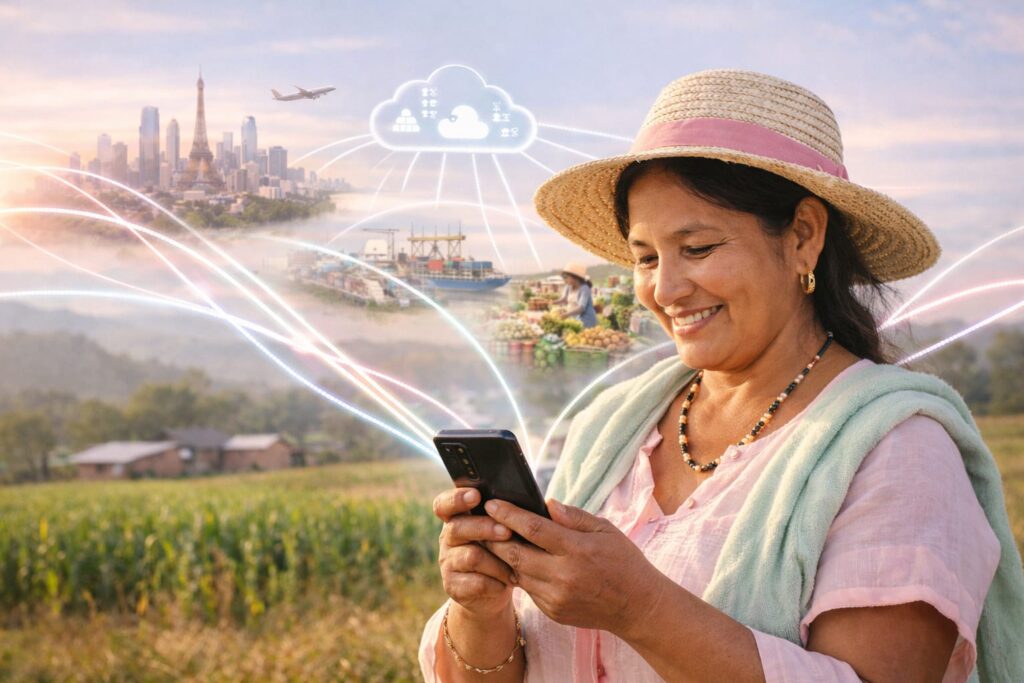
Digital inclusion holds transformative potential for rural women, who are often excluded by geography as much as gender.
Connectivity collapses distance. It links farmers to climate data, artisans to global markets, caregivers to telemedicine, and entrepreneurs to financial services. When rural women are digitally connected, local economies diversify, migration pressures reduce, and regional inequalities narrow.
Public investment in rural broadband, affordable devices, and local-language platforms is not social spending, it is strategic economic development.
When rural women go online, villages become economic engines rather than sites of neglect.
The Price of Political Inaction
Failure to close the digital gender gap is not neutral. It is costly.
Economies that exclude women digitally experience slower growth, weaker innovation, and deeper inequality. Democracies lose participation. Labour markets lose talent. Trust in institutions erodes.
In an increasingly digital global economy, exclusion is not only unjust, it is economically reckless. Nations that fail to include women online will fall behind those that recognise gender equality as a competitive advantage.
Rewriting the Digital Social Contract
The path forward demands more than symbolic commitments. It requires a digital social contract rooted in equity, accountability, and participation.
Governments must design digital policies with women, not merely for them. Data must be gender-disaggregated. Budgets must reflect inclusion priorities. Public–private partnerships must centre rights, not extraction.
Closing the digital divide is not a one-time project; it is a sustained political responsibility.
As Amartya Sen reminds us:
“Development is freedom.”
In the digital age, freedom begins with access and flourishes with inclusion.
When Women Connect, Economies Compete
The question is no longer whether we can afford to include women in the digital economy. The question is whether we can afford not to.
Women online are not a niche demographic. They are economic multipliers, innovation drivers, and democratic stabilisers. Politics that close the digital divide do more than empower women they future-proof nations.
When women connect, markets expand.
When women lead online, systems become fairer.
When women are digitally empowered, economies grow stronger and societies become more just.
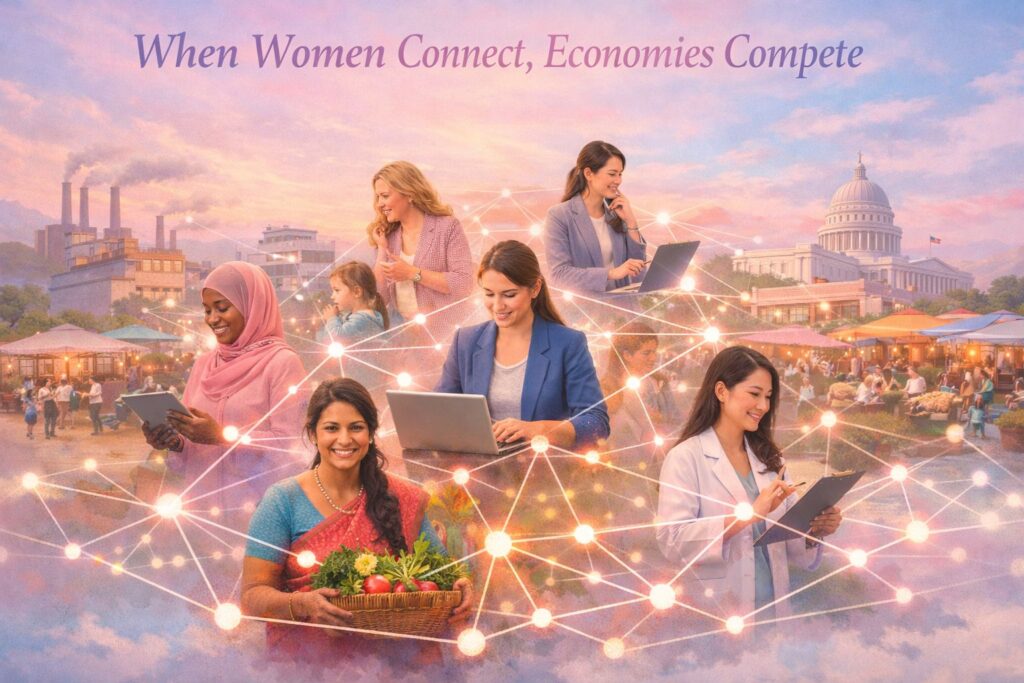
Women online do not weaken economies. They make them unbreakable.
References & Further Reading
- UN Women – Gender Equality and Digital Transformation
https://www.unwomen.org - World Bank – Digital Development and Gender Inclusion
https://www.worldbank.org/en/topic/digitaldevelopment - International Telecommunication Union (ITU) – Measuring Digital Development
https://www.itu.int - OECD – Bridging the Digital Gender Divide
https://www.oecd.org/digital - UNESCO – Digital Skills for Women and Girls
https://www.unesco.org - World Economic Forum – Global Gender Gap Report
https://www.weforum.org