

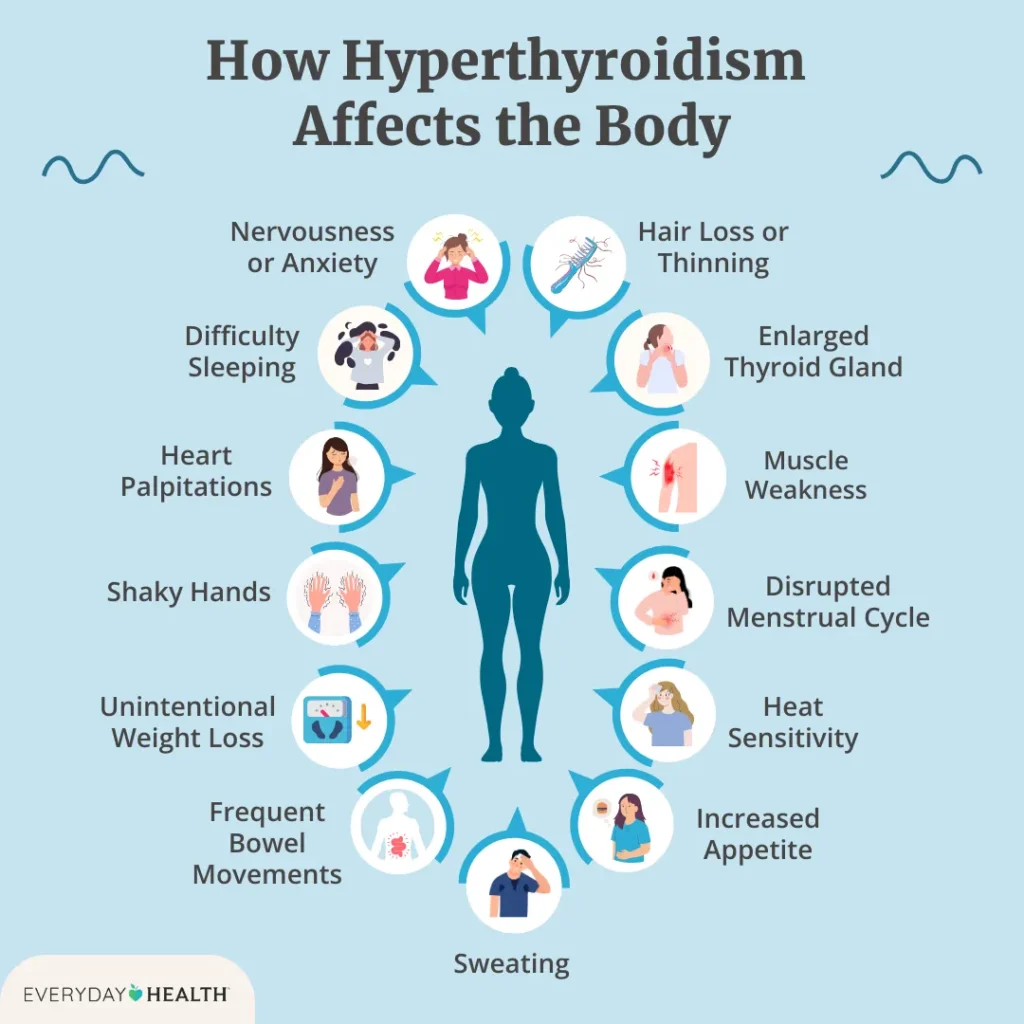
You’re constantly wired, irritable, losing weight unintentionally, and your heart feels like it’s running a marathon. You go to the doctor, describe these feelings, and you’re often sent home with a prescription for anxiety medication. If this sounds familiar, you may be experiencing Hyperthyroidism, or an overactive thyroid—a condition that affects women up to ten times more frequently than men.
The thyroid gland acts as the body’s master control for metabolism. When it goes into overdrive, it speeds up every system in your body. Because the classic symptoms are so often attributed to lifestyle factors (stress, caffeine, anxiety), this condition remains chronically under diagnosed in women.
This article will help you identify the 7 most overlooked symptoms, understand the root cause (often autoimmune), and explore effective holistic strategies to calm your system down and reclaim your energy.
The Core Mechanism: An Accelerator Stuck Down
The thyroid gland is a butterfly-shaped organ located at the base of your neck. Hyperthyroidism occurs when the gland produces excessive amounts of its main hormones: Thyroxine (T4) and Triiodothyronine (T3).
These hormones dictate the speed at which every cell in your body works. When you have high levels of T3 and T4, your entire system runs too hot and too fast:
Brain: You feel anxious, irritable, and restless.
Heart: Heart rate speeds up, causing palpitations.
Muscles: You feel weak and shaky.
Gut: Metabolism accelerates, leading to weight loss and frequent bowel movements.
This condition is diagnosed via a blood test that usually shows very low TSH (Thyroid Stimulating Hormone, the signal from your brain to the thyroid) and high Free T3 and Free T4 (the active, circulating hormones).
7 Overlooked Symptoms That Mimic Anxiety
It is easy to recognize sudden, dramatic weight loss. But the subtler, emotional, and physical shifts often go unaddressed for years. These are the symptoms women often dismiss as “normal stress.”
•Extreme, Constant Anxiety: This is often the first symptom. It’s not situational anxiety; it’s a profound, persistent physical agitation and inability to relax or sit still.
•Heat Intolerance: You feel uncomfortably hot all the time, even when others are cool. You may sweat excessively, especially at night.
•Insomnia and Restlessness: You feel exhausted but unable to fall asleep, or you wake up feeling like your heart is racing.
•Menstrual Irregularities: High thyroid hormone levels can interfere with the production of sex hormones, leading to lighter periods, less frequent periods, or even amenorrhea (loss of your period).
•Fine Hair and Skin Changes: Your hair becomes very fine and may fall out easily. Your skin may feel warm, moist, and soft.
•Muscle Weakness and Tremors: You may notice a subtle, fine tremor in your hands, making it hard to write or hold things steady. Climbing stairs or reaching for high objects becomes tiring.
•Eye Changes (Graves’ Specific): If the cause is autoimmune, you may experience pressure, redness, dryness, or a visible change in the eyes (exophthalmos, or bulging).
The Autoimmune Link: Understanding Graves’ Disease
In approximately 80% of hyperthyroidism cases, the cause is an autoimmune disorder called Graves’ Disease.
In Graves’ Disease, your immune system mistakenly produces antibodies (Thyroid-Stimulating Immunoglobulin, or TSI) that mimic TSH. These antibodies continuously “trick” the thyroid gland into producing T3 and T4 at maximum capacity, resulting in the overdrive state.
Identifying the autoimmune component is crucial for holistic management because it changes the focus from just lowering hormones to calming the underlying immune system dysregulation.
Holistic Strategies for Management
While conventional treatment (medication, iodine therapy, or surgery) is often necessary for Graves’ Disease, these holistic strategies can work in concert to reduce inflammation, manage symptoms, and support the body.
A. Diet and Nutritional Support
Avoid High-Iodine Foods (Crucial for Graves’): Since iodine is the raw material for thyroid hormones, reducing intake can help slow production. Limit or avoid seaweed, excessive iodized salt, and some dairy/eggs.
Focus on Anti-inflammatory Eating: Prioritize a diet rich in vegetables, lean proteins, and healthy fats. Eliminate processed sugars and refined grains, which drive the systemic inflammation that fuels autoimmune activity.
Limit Caffeine: Caffeine acts as a stimulant, magnifying the already overstimulated symptoms (anxiety, palpitations). Cutting back dramatically can provide immediate symptom relief.
B. Supplementation (Consult Your Doctor)
L-Carnitine: This supplement can block the uptake of thyroid hormones (T3/T4) into the cell nuclei, essentially reducing their effect on the body’s metabolism and calming symptoms.
B Vitamins: Essential for nervous system health, B vitamins help support adrenal function, which is often taxed by the high metabolic rate of hyperthyroidism.
Vitamin D: Correcting low Vitamin D is critical, as deficiency is strongly linked to autoimmune diseases like Graves’.
C. Stress and Nervous System Management
Vagus Nerve Toning: Engage techniques that calm the nervous system (Vagus Nerve) to counteract the anxiety response. This includes humming, gargling, and slow, deep, diaphragmatic breathing.
Gentle Movement: Replace high-impact exercise (which spikes the heart rate) with restorative practices like Yin Yoga, Tai Chi, or slow walking to manage stress without over-stressing the body.
If you recognize these symptoms, do not settle for an anxiety diagnosis alone. Ask your doctor for a complete thyroid panel (TSH, Free T3, Free T4, and Thyroid Antibodies: TSI/TPO). Getting the right diagnosis is the first and most powerful step toward finding peace.